Who Is The Tenth Man
The Idea Behind the Title
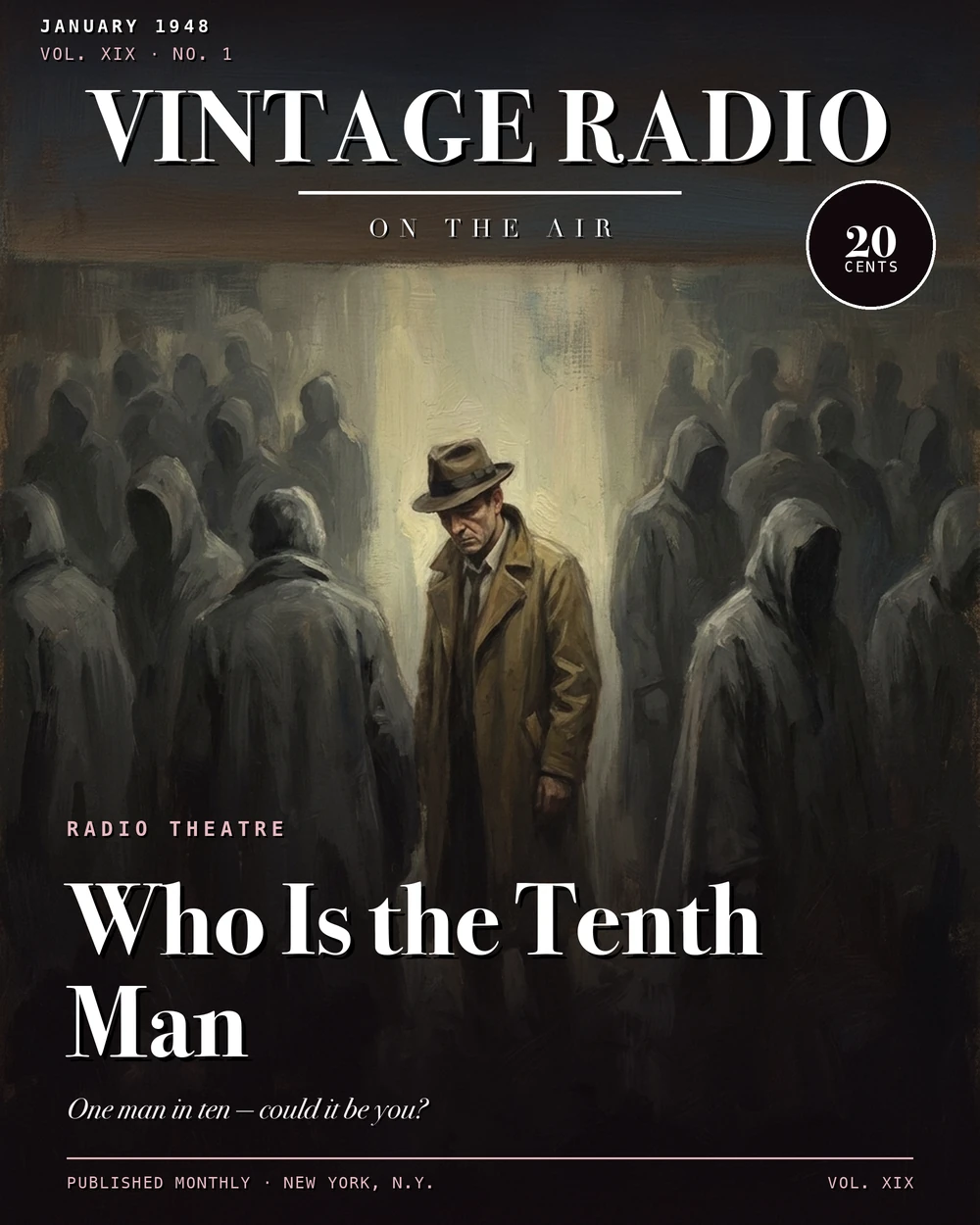
The title sounds like a thriller, but the show had nothing to do with wartime execution or survival odds. The "tenth man" in this series was a public health statistic: one person in ten in the community would, at some point in their life, need some form of psychiatric care or treatment. That single number was the engine of the whole project. Each of the thirteen episodes broadcast between October 17, 1947, and January 16, 1948, dramatized a specific mental health situation — drawing the listener's attention to conditions and circumstances that most Americans in 1947 preferred not to discuss out loud.
The show was produced by the National Mental Health Foundation and aired on NBC, which puts it in a distinct category from the dramatic anthologies of the same era. This wasn't entertainment dressed up with a social conscience on the side. It was a public-service radio drama with an explicit educational mission, described in OTR research catalogs as "altruistic and educational." The Foundation had a specific agenda — reform of the psychiatric care system — and the series was one of the tools it used to advance that cause.
The Organization That Made It
The National Mental Health Foundation was founded in 1946 by Harold Barton and associates who had served as conscientious objectors assigned to work in state psychiatric hospitals during World War II. What they witnessed there — the abusive conditions, the neglect, the near-total absence of meaningful treatment — drove them to create an organization dedicated to exposing those conditions and pushing for change.
The timing of the series was not accidental. It aired in the immediate aftermath of the National Mental Health Act of 1946, the legislation that made federal funding available for psychiatric research and care for the first time. The country was just beginning to reckon with the scale of mental illness as a public health issue, and the NMHF moved quickly to use the reach of network radio as part of that reckoning. Thirteen episodes over thirteen weeks on NBC gave the Foundation a national platform at exactly the moment the policy conversation was opening up.
What Each Episode Did
The series ranged across a wide span of mental health concerns, from children's issues to problems faced by the elderly. Topics dramatized across the run included depression, loneliness, social phobias, and — notably — the discrimination people faced after receiving mental health treatment. That last theme was pointed: the stigma attached to psychiatric care was itself a barrier to people seeking help, and the series addressed it directly rather than skirting around it.
The first episode, "Punishment Without Crime," told the story of mental health reformer Dorothea Dix and her nineteenth-century campaign to improve conditions in American asylums. Starting there was a deliberate choice — it anchored the series in a longer reform tradition and framed the contemporary moment as part of an ongoing struggle rather than something entirely new. Other episode titles across the run — "Out Of The Shadows," "Which World For Susan," "The Old Folks At Home," "Love Without Words," "The Child Is Father To The Man" — suggest the range of subjects the series addressed, moving through different life stages and different kinds of psychological difficulty.
The complete set of thirteen episodes has been certified as a preserved collection, with certification dated January 22, 2007. All thirteen broadcasts are accounted for.
The Voices on the Air
The series had two familiar radio voices anchoring it for listeners. Ralph Bellamy served as narrator. Bellamy was well established as a stage and film actor by 1947 — he had received an Academy Award nomination for The Awful Truth in 1937 — and would later win a Tony Award for Sunrise at Campobello. His presence lent the series a degree of credibility and weight that a less recognizable voice might not have provided for a show tackling subjects many listeners found uncomfortable.
Jackson Beck handled the announcing duties. Beck was a veteran radio voice actor whose best-known work included serving as the announcer on The Adventures of Superman and voicing Bluto in the Famous Studios Popeye theatrical shorts. He was one of the most recognizable voices in radio at the time, and his association with the series connected it, at least sonically, to the mainstream of commercial broadcasting even as the content pushed well outside those norms.
Why It Stands Apart
Most dramatic anthologies of the late 1940s drew from the same general pool of material — crime stories, adaptations of popular fiction, tales of romantic complication or wartime adventure. Who Is The Tenth Man was doing something different in kind, not just in subject matter. The Foundation wasn't trying to entertain first and educate second. The episodes were designed to make mental illness visible, to reduce the sense of shame around seeking treatment, and to push listeners toward accepting that psychiatric care was a legitimate form of medicine.
That context shapes how the series reads now. Thirteen episodes is a short run, and a public-service drama on NBC was never going to command the audience of a sponsored commercial program. But the series exists as a specific artifact of the post-war mental health reform movement — radio used as a direct instrument of a public health campaign, at a moment when that campaign was just getting organized at the national level. The episodes that survive reflect what the National Mental Health Foundation thought radio could do, and what they needed the public to understand.